
Review · CHICAGO
Chicago Architecture Center River Cruise aboard First Lady
Chicago’s best architecture tour is also one of its easiest sightseeing rides: you sit on the river while the city’s skyscrapers rise around you. From Chicago’s First Lady, a Chicago Architecture Center docent explains why buildings such as Marina City, Willis Tower, and 150 North Riverside look the way they do, rather than simply naming them as you pass.
I like the expert docent commentary, which gives the 90-minute ride real substance, and I like the choice of open-air or heated indoor seating. Guides such as Cynthia, Laura, Amy, Russell, Nick, and Mark have all been praised for clear, lively presentations. The main drawback is that the ticket costs $57 and cannot be changed or refunded, so you need to pick your departure carefully.
Key points to know before booking
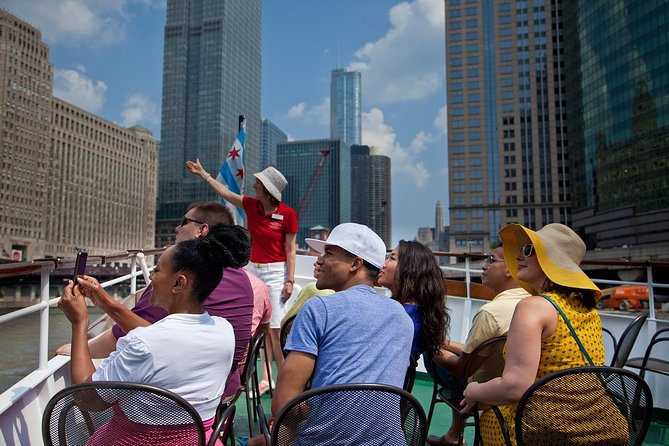
- The river is the classroom: You get close views of Chicago’s major towers, bridges, and changing riverfront.
- The guides make the difference: Chicago Architecture Center docents explain design, engineering, city planning, and local history.
- Arrive 30 minutes early: Seating is general admission, and boarding is first come, first served.
- The boat works in poor weather: An open upper deck and climate-controlled lower salon give you a choice.
- The route packs in major landmarks: Expect Navy Pier, Marina City, Trump Tower, Willis Tower, 150 North Riverside, and more.
- The $57 price buys context, not just scenery: It is most useful early in your Chicago visit, when the city still needs a map in your head.
Why this Chicago river cruise is worth your time
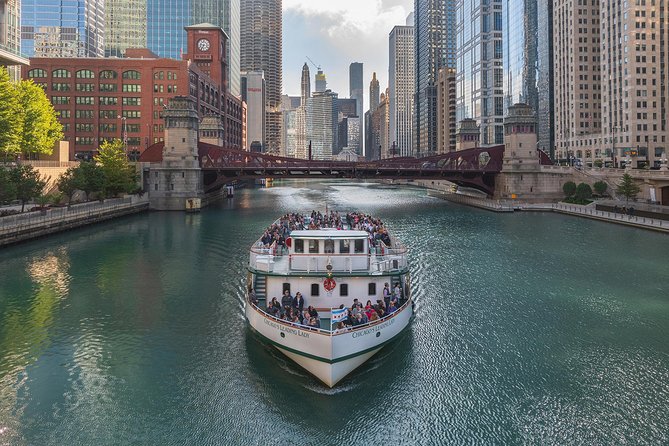
Chicago’s skyline can feel like a wall of glass, steel, concrete, and strange shapes when you first arrive. From street level, you often see only one building at a time. The river cruise fixes that problem by giving you a moving view of the city’s architecture from the water.
The Chicago Architecture Center connection matters. Your guide is a trained docent, not simply a narrator reading building names from a script. The best guides explain how a tower fits its neighbors, why Chicago grew around the river, and how engineering limits shaped the skyline.
I especially like this as a first-day activity. One guide helped passengers connect the buildings seen from the boat with places they visited later on foot. That is the practical value of the cruise: it gives you a mental map before you start exploring the Loop, River North, Magnificent Mile, and riverwalk on your own.
At $57 per person, this is not the cheapest way to see downtown. A stroll along the river costs nothing, and you can admire many buildings from Wacker Drive without buying a ticket. But the cruise combines transportation, close views, and 90 minutes of guided interpretation. If you care about architecture or want a strong introduction to Chicago, the cost is fair.
The tour has earned a 4.9 rating from more than 5,500 reviews, with 98 percent recommending it. That points to unusually steady quality, especially in the guiding. Still, the experience depends on weather, seating position, and your guide’s delivery, so it is wise to treat the cruise as an informative sightseeing ride rather than a private architectural seminar.
More River Cruises in Chicago:
- Chicago Architecture River Cruise
★ 5.0 · 15,756 reviews - Chicago: Architecture River Cruise Skip-the-Ticket Line
★ 4.8 · 4,325 reviews - Chicago: 45-Minute Family-Friendly Architecture River Cruise
★ 4.7 · 2,304 reviews
Boarding at Wacker Drive
The dock is at 112 East Wacker Drive, along the Chicago Riverwalk. The entrance is on the northeast corner of Michigan Avenue and Wacker Drive, close to the river and within easy reach of Millennium Park and the Magnificent Mile.
Give yourself at least 30 minutes before departure. The ticketing office is at Riverwalk level, and you need time for the boarding process. In summer, allow extra time because the area can be crowded.
There is no elevator access to the boat dock. You will use stairs to reach the boarding area, so this is important if you have mobility concerns or are carrying anything awkward. The activity is near public transportation, and the nearest listed parking facility is the LAZ garage at 111 East Wacker Drive. Parking costs extra.
Do not bring luggage. There is no luggage storage on the dock or onboard. Leave suitcases at your hotel, and bring only what you need for the cruise.
All seating is general admission. Any seat numbers printed on your ticket are not valid, so arrive early if you want the first choice of seats. The boat can hold up to 250 people, which gives the ride a lively group feel but means late arrivals may have fewer seating options.
Settling aboard Chicago’s First Lady
Chicago’s First Lady has an open-air upper deck and an enclosed lower salon with climate control and large windows. This arrangement is one of the tour’s strongest practical features.
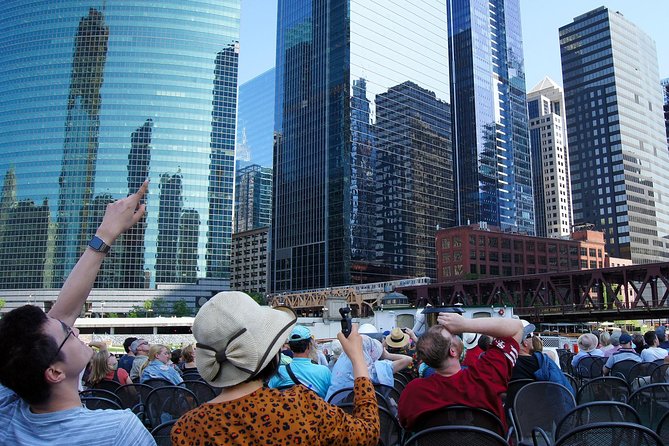
On a mild, sunny day, the upper deck gives you the best sense of height and space. Look up toward the tops of the towers, watch bridges lift and turn, and keep your camera ready as the boat passes between buildings. The sun can interfere with views, so bring sunglasses, a cap, or a visor.
The lower salon is the sensible choice in rain, wind, or cold weather. The boat sails in all weather, and the heated indoor area has been especially welcome on chilly days when the river is shaded by tall buildings. The large windows still let you see the skyline, though reflections and other passengers can affect photographs.
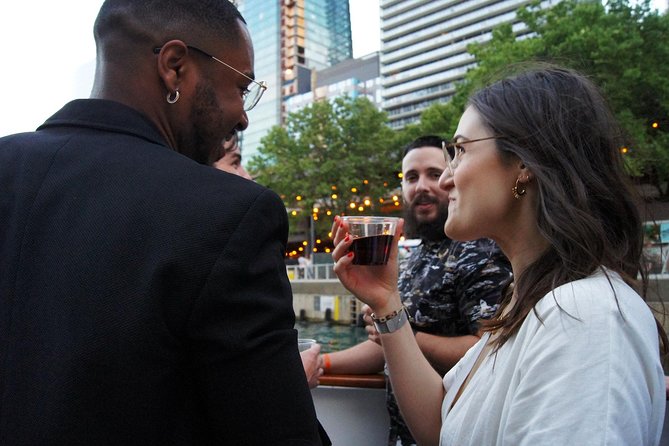
There is a full bar onboard, with drinks and light snacks available for purchase. Hot chocolate has been a particular hit on cold departures. Restrooms are available, but they close 15 minutes before the tour ends for safety reasons.
The boat is described as clean, spacious, and comfortable. There is no WiFi, but that is hardly a serious loss here. Your attention is better spent looking up.
The Chicago River tells the city’s story
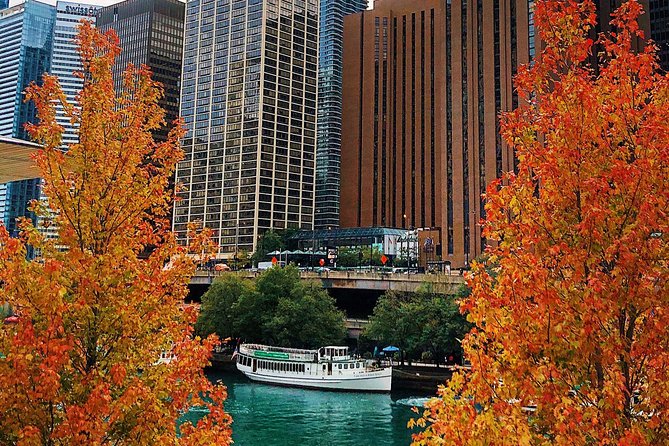
The river is more than a scenic route. It helps explain Chicago’s growth, industry, transportation, and later riverfront renewal.
As the boat moves along, your guide places the buildings in the city’s larger story. You hear how the riverfront changed from a working industrial corridor into a place for offices, residences, restaurants, walking paths, and sightseeing boats.
That setting makes the commentary easier to understand. Instead of hearing isolated facts about towers, you see how Chicago repeatedly reused the river and its surroundings. The city’s architecture becomes a record of changing needs and changing ideas about urban life.
The boat does not travel a huge distance, and one passenger wished the route went farther. That is a fair limitation. This is a focused downtown architecture cruise, not a full tour of every part of the Chicago River. The benefit is a concentrated view of the central skyline within 90 minutes.
Same water, a different way to see it:
- Chicago: 1.5-Hour Lake and River Architecture Cruise
★ 4.7 · 2,050 reviews - Chicago River 90-Minute Architecture Boat Tour
★ 5.0 · 1,635 reviews - Chicago Architectural River Cruise
★ 4.5 · 804 reviews - Chicago by Night River and Lake Cruise
★ 4.6 · 791 reviews
Navy Pier and Chicago’s habit of reuse
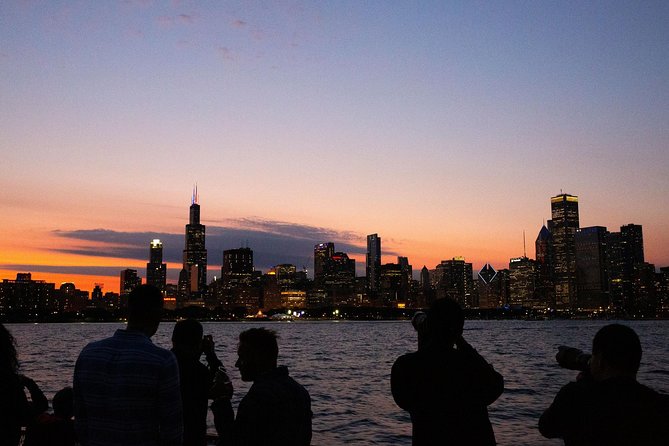
Navy Pier appears as an example of adaptive reuse. Its past includes a naval base, university campus, and shipping center before it became an entertainment destination.
From the river, you get a useful sense of Navy Pier’s position within the city. It is not just a place for rides, restaurants, and lake views. Its changing roles reflect Chicago’s ability to give old infrastructure new purposes.
The pier is not the main subject of the cruise, and you should not expect an extended stop. It is viewed from the water as part of the wider city story.
Marina City, the city within a city
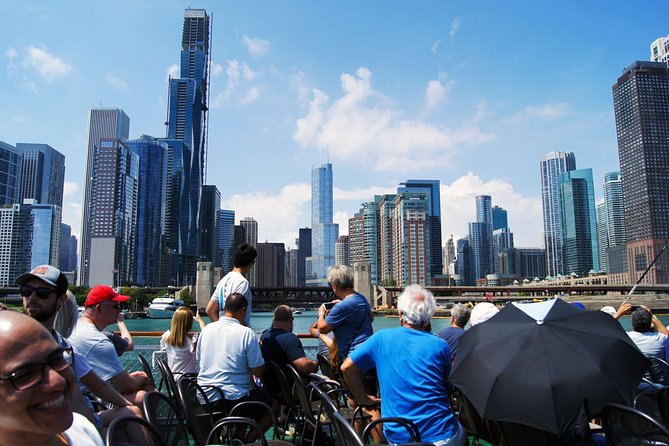
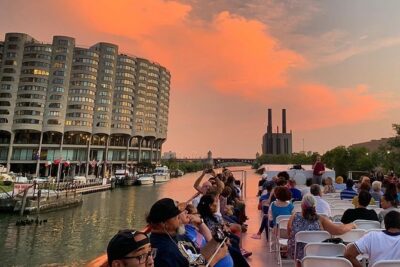
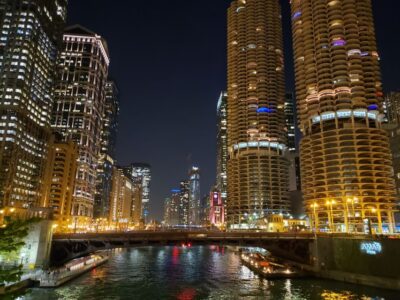
Marina City is one of the river’s most recognizable sights. Its two rounded towers were designed by Bertrand Goldberg as an urban experiment at a time when many middle-class residents were moving to the suburbs.
The towers were meant to draw people back into the city by combining homes and city amenities in one striking complex. Their corn-cob shape makes them easy to identify, but the guide’s explanation gives the design a reason beyond visual novelty.
This is one of the moments when the cruise is better than a quick photo from a bridge. You see the towers from a useful angle and hear how their form connected to a social goal. The boat also lets you compare Marina City with the more rectilinear towers around it.
Trump Tower and the idea of architectural conversation
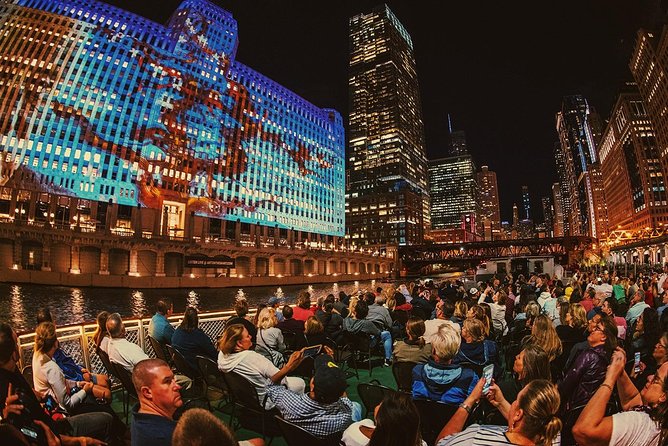
The Trump International Hotel & Tower comes into view as a large glass and steel building beside older and newer neighbors.
The docent’s point here is that the tower reflects more than its materials. Its design responds to the river, nearby buildings, and the broader downtown setting. That idea of buildings being in conversation with one another is a recurring strength of the tour.
You are not simply told that one building is old and another is new. You are encouraged to notice proportions, surfaces, placement, and how a structure meets the river. Those observations help you read the rest of Chicago’s skyline with more confidence.
Mies van der Rohe and modernist restraint
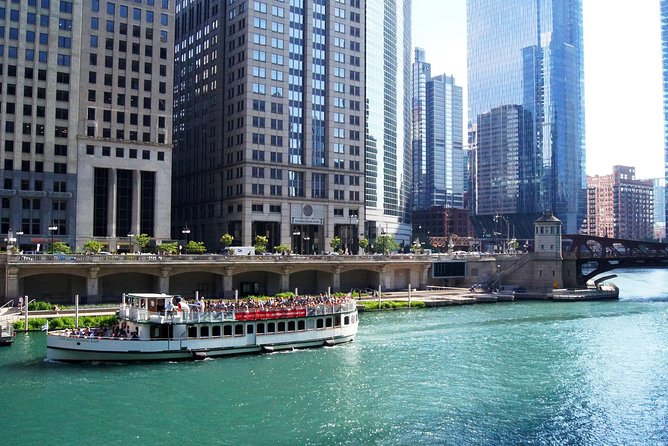
One of the last American projects designed by Ludwig Mies van der Rohe occupies an important position along the river. Its powerful Modernist design offers a sharp contrast to the rounded Marina City towers and more expressive contemporary buildings.
Mies’s work is useful for understanding the range of Chicago architecture. Some buildings make an impression through bold curves or unusual engineering. Mies often worked through order, structure, repetition, and restraint.
The boat gives you time to compare these approaches without rushing from one address to another. If you are new to architecture, this side-by-side contrast can make abstract design ideas much easier to see.
150 North Riverside and the engineering show
150 North Riverside is one of the cruise’s most dramatic engineering subjects. The tower appears to rise from a narrow base, creating a gravity-defying impression as it climbs above the river.
This is where the guide’s engineering explanations add real value. From street level, you may notice the building’s unusual shape without understanding what makes it possible. From the boat, you get a clear view of the structure and a short lesson in how modern towers can use engineering to create open space at ground level.
You also view the Boeing International Headquarters at 100 North Riverside Plaza. The cruise does not turn each building into a long lecture, but the sequence gives you a broad sample of Chicago’s modern riverfront architecture.
Willis Tower and the scale of Chicago
Willis Tower, formerly the Sears Tower, held the title of the world’s tallest building for nearly 25 years. From the river, its height is easier to grasp than it is from a sidewalk.
The tower’s size changes as the boat moves. It appears behind neighboring buildings, then opens into view as a dominant vertical marker. This is another reason the river route works so well: you are constantly changing position, so the skyline has movement rather than a fixed postcard view.
The cruise also passes the former Marshall Field’s wholesale warehouse, completed in 1930. It was once the largest building in the world and served as a place where retailers purchased stock.
That stop adds a useful reminder that Chicago’s architectural story is not only about gleaming office towers. Warehouses, retail infrastructure, shipping, and commerce helped shape the city just as much as famous skyscrapers did.
The Chicago Mercantile Exchange and Tribune Freedom Center
The Chicago Mercantile Exchange Building at 20 South Wacker Drive represents the city’s continuing role in business and finance. It is one of several stops that connect Chicago’s architecture to the work done inside these buildings.
You also view the Chicago Tribune Freedom Center. The river route lets you see how large-scale commercial and media buildings fit into the working downtown environment.
These sights may be less famous than Willis Tower or Marina City, but they help prevent the tour from becoming a parade of only the best-known landmarks. You get a broader picture of the city’s buildings, their uses, and their place along the river.
How the guides shape the experience
The strongest part of this cruise is the docent. Names noted for particularly engaging presentations include Cynthia, Laura, Amy, Russell, Nick, and Mark. You should not expect a particular guide on a specific departure, but the tour’s format gives each docent room to explain the city in a personal, lively way.
Good delivery matters on a boat tour. The group can be large, the wind can interfere with sound, and there are plenty of distractions overhead. The most successful guides keep the pace moving, explain technical ideas in plain language, and connect buildings to Chicago’s social and economic past.
The commentary covers architects, bridges, building design, engineering, and city development. Some guides also add personality and current city context. That mix keeps the 90 minutes from feeling like a list of dates and names.
Children can participate, but the experience is not recommended for children younger than 12. Young people who enjoy buildings, city views, or engineering may follow along well. Very young children may find the 90-minute presentation slow, especially if the weather limits time on the upper deck.
Timing, weather, and the best seat strategy
You can choose from several departure times, including evening options. Evening departures offer changing light on the buildings and can be especially appealing for photographs, though the tour still depends on weather and visibility.
Dress for the elements. The upper deck can be sunny, windy, or cold, while the lower salon may be more comfortable but less ideal for unobstructed photos. On a cold day, even a sunny cruise can feel chilly when the boat passes into the shade of the towers.
Arrive early, then decide whether you value the open-air view or indoor comfort. If you want both, start outside when conditions are good and move inside if needed. Seating is not assigned, so the early arrival advice is practical, not ceremonial.
The route, vessel, and schedule can change without notice. Tickets are non-refundable and cannot be transferred to another departure. Book only when your schedule is firm.
Who should book this cruise?
I would choose this tour for a first visit to Chicago, especially if you want a clear introduction to the downtown skyline before exploring on foot. It also suits architecture fans, photographers, couples, solo visitors, and families with older children.
It is less suitable if you dislike guided commentary, need a fully step-free route to the dock, or want to travel with luggage. The $57 cost may feel high if your only goal is a short boat ride, but it makes better sense when you value the docent’s explanations.
Should you book Chicago’s First Lady?
Yes, if you want Chicago’s buildings explained rather than merely photographed. The 90-minute route covers a large part of the central riverfront, and the combination of a trained docent, strong skyline views, indoor shelter, and a bar makes it a well-rounded city experience.
Book it near the start of your stay so you can use the information afterward. Arrive 30 minutes early, leave your luggage at the hotel, dress for shade and wind, and do not count on changing the ticket later.
Skip it if you want a quiet, unstructured cruise or if $57 feels too high for a guided outing. For most visitors interested in Chicago’s architecture, though, this is one of the most efficient ways to understand the city in a single sitting.
FAQ
Where does the Chicago Architecture Center River Cruise depart?
The cruise departs from the Chicago Riverwalk at 112 East Wacker Drive. The entrance is at street level on the northeast corner of Michigan Avenue and Wacker Drive.
How early should I arrive?
Arrive 30 minutes before departure. Allow extra time during summer, when the area may be busier.
How long is the cruise?
The cruise lasts approximately 90 minutes and returns to the original meeting point.
Is seating assigned?
No. Seating is general admission and boarding is first come, first served. Any seat numbers printed on tickets are not valid.
Is there indoor seating?
Yes. The boat has a climate-controlled lower salon with large windows. There is also an open-air upper deck.
Does the cruise operate in rain?
Yes. Sailings operate in all weather conditions. Dress appropriately, and use the enclosed lower salon in poor weather.
Can I buy food or drinks onboard?
Yes. A full bar is available, and drinks and light snacks can be purchased during the cruise.
Can I bring luggage or a pet?
Luggage cannot be brought onboard, and there is no luggage storage at the dock. Pets are not allowed, though service animals are permitted.
Is the cruise accessible by elevator?
There is no elevator access to the boat dock. The cruise is near public transportation, and most people can participate, but you should account for the stairs when planning your visit.
Newly reviewed in Chicago
- City Cruises Chicago: Brunch, Lunch, or Dinner River Cruise★ 4.7 · 128 reviews
- Chicago: Thanksgiving Gourmet Lunch Cruise on Chicago River★ 3.5 · 4 reviews
- Chicago: Tiki Bar Cruise on Chicago River or Lake Michigan★ 3.8 · 16 reviews
- Chicago River: 90-Min Architecture Boat Tour★ 4.9 · 29 reviews
- Chicago River 90-Min Architecture Boat Tour★ 4.5 · 24 reviews
- Chicago: Lake and River Tour on a RIB Boat★ 5.0 · 4 reviews
- Chicago River: 1.5-Hour Guided Architecture Riverboat Tour★ 4.7 · 93 reviews
- Chicago: First Lady River Cruise & Architecture Center Combo★ 4.7 · 24 reviews
Chicago River Cruises, compared side by side.
Architecture River Cruise Skip-the-Ticket Line
Read our review →
45-Minute Family-Friendly Architecture River Cruise
Read our review →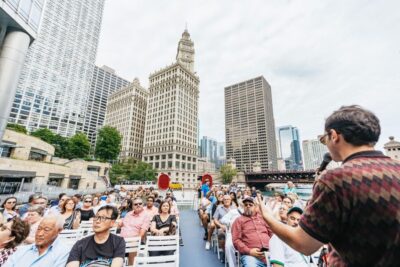
Chicago River 90-Minute Architecture Boat Tour
Read our review →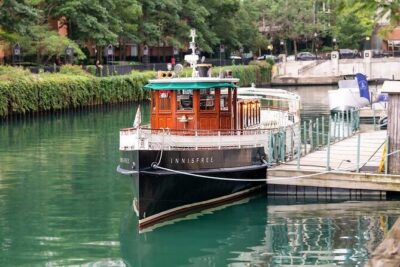
Chicago City Tour with Architecture River Cruise Option
Read our review →Lists this trip appears in